Cable Communication
'The Sopranos' medium as message

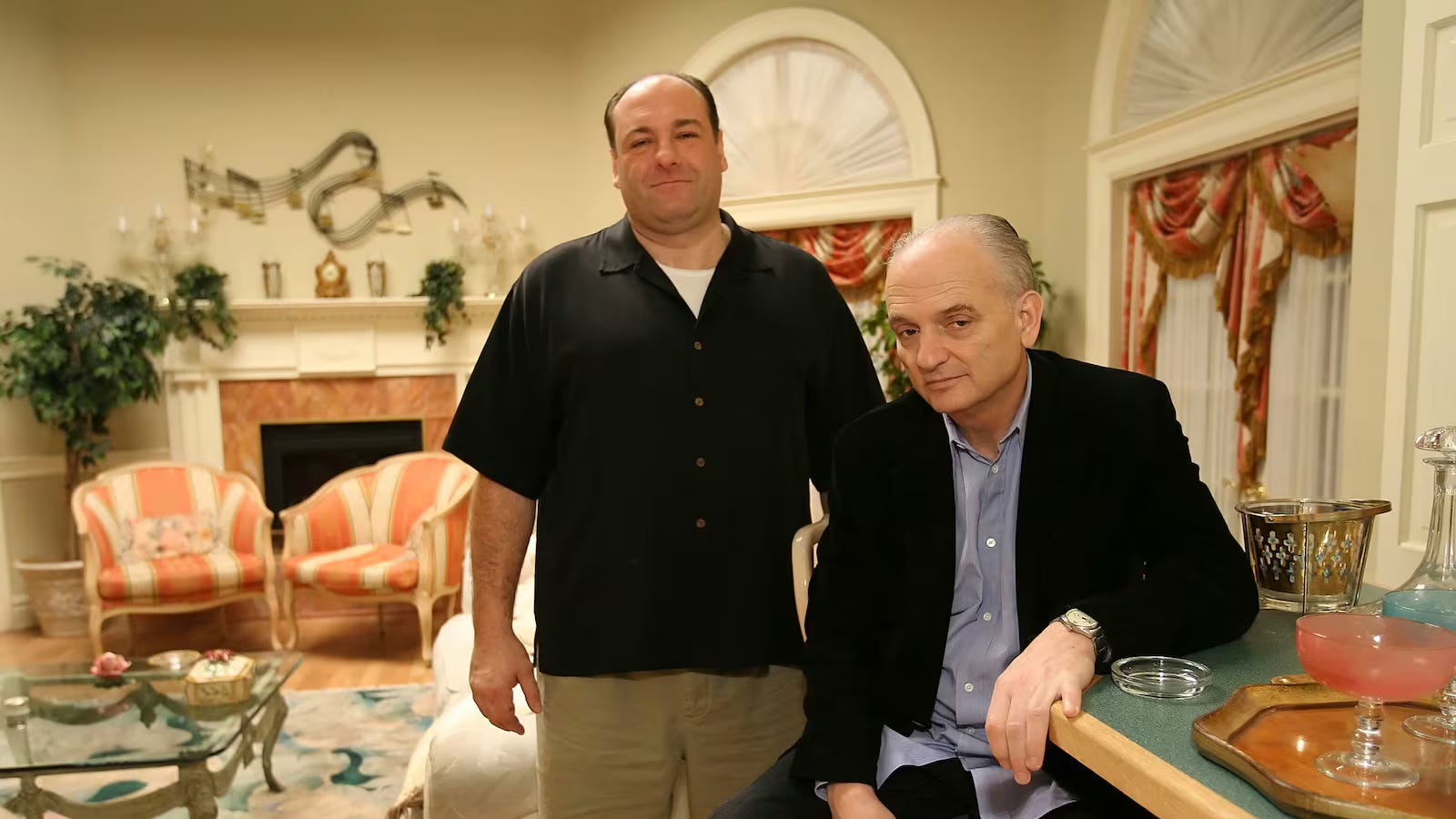
Before The Wire, before Breaking Bad, before Mad Men, there was The Sopranos—a show set in Springsteenland. Here’s another sample of what I’ve been working on lately. -Jim
Tony Soprano is the brainchild of David Chase, the writer, producer, and director who spent a quarter-century in the world of traditional network television. In the late 1990s he began working on a deeply personal project with strong autobiographical elements. It would take years before he successfully brought it to life.
Chase was born on August 22, 1945, in Mount Vernon, New York, which was (and to a great extent still is) a working-class Westchester suburban city immediately north of the Bronx and a few miles east of the Hudson River border with New Jersey. Chase—born David DeCesare—has a tangled blended family history with family names that include Bucco and Melfi, which would find their way into The Sopranos. His family heritage on both sides is (southern) Italian. Chase’s family relocated to Clifton, New Jersey, when he was a child, and then moved on to North Caldwell, site of the Soprano homestead for the length of the series. Chase’s father owned a hardware store in nearby Verona. A rock musician (he played drums) and film buff from an early age, he attended West Essex High School, from which Chase graduated in 1964. From there it was on to Wake Forest University before transferring to NYU, where he got a bachelor’s degree in the Tisch School for the Arts. Chase married his high school sweetheart in 1968 (their daughter, Michele DeCaesare, appeared in a number of Sopranos episodes). After knocking around for a few years on the West Coast, Chase enrolled in a film program at Stanford, where he earned his master’s degree in 1971. Like Springsteen, Chase was drawn to California, and lived there. But as with Springsteen, New Jersey continued to exert considerable pull on his imagination and would become the literal and figurative locus of his work.
For Chase, however, this would take a while. Over the course of the seventies and eighties, he established himself as a journeyman writer for a series of network television shows, notably The Rockford Files (1974-80), a drama about a L.A.-based private detective for which he wrote approximately 20 episodes and later supervised a set of TV movies about the character that aired in the early nineties. He was also involved in the development of several other shows, notably Northern Exposure (1990-95). Chase was certainly successful, as anyone who makes a living in the entertainment business is. But hardly a star—and certainly not someone on the cusp of a breakthrough in the history of television.
Chase had always hoped to be a film director, and in the mid-nineties began working on a project in which a series of personal interests converged. One was organized crime—his thesis project at Stanford was a movie about a gangster—whose culture he observed first-hand in the activities of the Boiardo Family, which operated in North Jersey. A second, related (some would complain conflated) subject was the culture and mores of Italian Americans. A third was mental health—Chase struggled with depression for much of his youth, and the character of Tony Soprano’s psychiatrist, Jennifer Melfi, was based on his own therapist. A major aspect of Chase’s difficulties was, as it is for so many people, his mother, who became the basis for Livia Soprano, the toweringly passive-aggressive figure who looms large over the story. Chase wove these elements into a script about a powerful gangster who, amid difficulties with his family and his Family, decides to go into therapy—a scenario fraught with irony and comedy.
He couldn’t sell it. In a way, that’s because the idea of a gangster fish-out-of-water tale was already in the cultural bloodstream. The wonderfully edgy director Jonathan Demme had played with it in his Long-Island-based 1988 comedy Married to the Mob, starring Alec Baldwin and Michelle Pfeiffer, and in 1997 the iconic Robert De Niro played a mob boss who turns to therapist Billy Crystal in the slight, amusing Analyze This! (1999), which spawned the sequel Analyze That! three years later.
Perhaps if he had more clout in the movie industry, Chase would have had an easier time making a feature film. So he turned back to his television roots, signing a development deal with Brillstein-Grey, a production company. They suggested doing the project as a TV series. “Why would I want to do that?” he replied. “It’s already been done.” But as Chase began thinking about it on the drive home, he began to see possibilities. “I started thinking about the fact that the guy had a wife and a son and a daughter, and the shrink could be a woman, and that the network drama was very female-oriented, so I thought, ‘Maybe that feature idea would work as a TV series.’”
It still wasn’t easy. The major television networks all turned the project down. So Brillstein-Grey suggested HBO. This was, in itself, an admission of defeat. In the context of the 1990s, television was still the poor stepchild of Hollywood filmmaking—and cable TV was the poor stepchild of broadcast TV. Cable dated back to the 1960s as an alternative to antenna access for residents of remote rural areas, and became more mainstream in the 1970s, led by HBO, as a source of live sporting events and previously released Hollywood movies shown without commercial interruption. In the eighties and nineties cable began to proliferate on a mass basis with the rise of specialized networks like MTV and the Weather Channel. But cable as a source of original programming was still a somewhat unusual, and not especially prestigious, feature of the TV landscape.
This was the tentative context for HBO taking on The Sopranos—and the tentative basis on which the network did so. For a while it was unclear if Chase’s project would be anything more than one-off in the form of a pilot that functioned as a de facto movie that aired in January of 1999. The network eventually ordered a season, but it was far from clear for a long time whether it would go on any longer than that (the cast and crew were on tenterhooks for months of anxious waiting). Only after the show’s rhapsodic reviews and the word of mouth that followed did it become clear that HBO had a hit on its hands. In the years that followed, The Sopranos became much more than that: a demonstration of what the medium could do, the springboard for a series of other shows for the era that came to be known as Peak TV—among them The Wire (2002-2008), Breaking Bad (2008-2013) Mad Men (2007-2014)—that followed, and finally as a major work in the firmament of American cultural history.
Television is a very different medium from popular music, and David Chase is a very different man from Bruce Springsteen. But it’s worth noting in passing that the structural circumstances that allowed both to flourish shared broad similarities. Both were driven people who achieved a discrete level of success on the basis of their evident talent and energy. Both labored in media (Chase longer than Springsteen) that were not especially initially able or willing to accommodate the full scope of their ambitions. But both were working in commercial climates that were flush with cash and willing to experiment by subsidizing likely failures in the hopes of achieving outsized success. This allowed people like them to square the circle of pursuing deeply personal artistic visions that had a collective cultural impact.
That’s because these deeply personal artistic visions were embedded in resonantly historical states of mind.
Next: Springsteen and the Sopranos as white ethnics in a post-Civil Rights age.