Middle Aging
How a major literary novelist took a page from Springsteen's (song)book

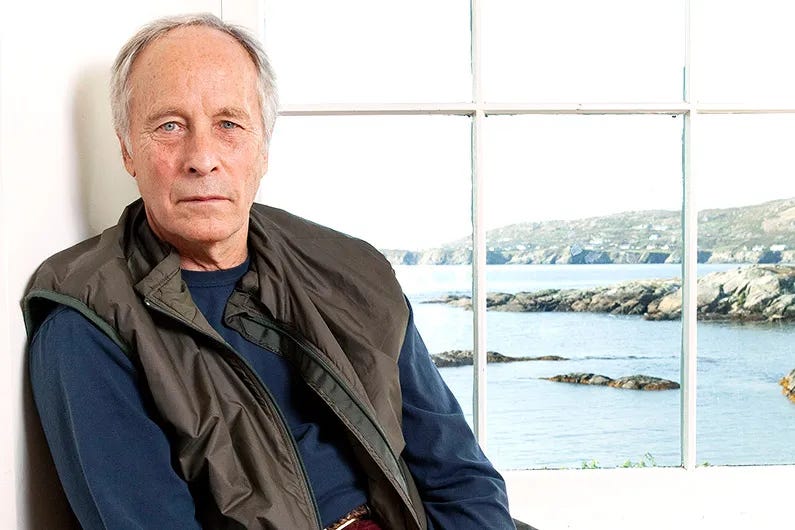
As some of you may know, I’ve embarked on a project with the working title of “Springsteenland,” comparing the literal and figurative landscapes of The Boss’s New Jersey with those of his contemporaries. Here’s a draft of an introductory chapter on Pulitzer Prize-winning novelist Richard Ford, whose five-novel Frank Bascombe series was inspired by Springsteen.
In 1978, the novelist Richard Ford had a short-term teaching gig at Williams College, one he landed on the strength of his debut novel A Piece of My Heart (1976), a gothic tale set on the Mississippi River. He was having a conversation with one of his students, who mentioned the music of Bruce Springsteen, with which Ford, then in his late twenties, was unfamiliar. The student invited Ford back to his dorm, where he played “Wild Billy’s Circus Story,” the closing track on The Wild, the Innocent, and the E Street Shuffle. Ford had attended circuses at the Arkansas State Fair in Little Rock as a child, where his uncle booked carnivals. “I’d wander around nights wherever I could slip in and get a whiff of that back-of-the-lot life—the carny people, the performers and the smell and density of things, he remembered. “Wild Billy,” Ford later wrote in the Wall Street Journal, captured “the louche danger and sweet longing of the carnival better than anything I know.”
Over the course of the ensuing years, Ford, five years his senior, became a Springsteen fan. He continued to cherish the complex, almost anarchic spirit of the songs. Here’s Ford in a 1985 essay for Esquire trying to capture Springsteen’s appeal:
“Hungry Heart” is, at its core, a bleak and irresolute vignette about a married guy, with kids, in Baltimore, who takes a drive and keeps on driving. First a bar. Then a woman. Then a bar again. And finally nowhere worth telling. Springsteen sets these little Cheeveresque woes to some friendly, rambunctious carny music—music tinted with tumult and longing—something you’d hear if you hung around a bandwagon at a circus, or maybe around Asbury Park (a piano, and a saxophone sounding like a tuba). The bridge between these two hard-to-reconciles—his music and his lyrics—is Springsteen’s chesty delivery, as he marches down through the words in a wide-eyed, forthright way, hardly heeding the understory, and ending up with the sentiment that, after all, everybody just needs a home and a place to rest.
By the early eighties, Ford was living in New Jersey (his wife had a job as a city planner in Princeton). He was writing prose in a similar vein of reflective restlessness—Ford’s second novel, The Ultimate Good Luck (1981), a thriller set in Mexico, was rendered in taut, Hemingwayesque prose—and the new work wasn’t going well. “I ran out of luck as a writer and needed to resurrect my writing life,” he said.
Ford, a native Mississippian, had lived around the country, and had written fiction set in a variety of locations. Now he decided to set down literary roots in the Garden State. “Springsteen’s New Jersey songbook was instrumental to my believing that the Garden State was a fit subject and setting,” he wrote in the Journal.
Ford elaborated on the appeal of New Jersey—a place he continued to write about long after he had left—in an email exchange with his editor at The New Yorker a quarter-century later. “I just looked around and asked myself, ‘What do I know anything about?’ I knew, it seemed, a few things about New Jersey. I liked New Jersey quite a lot. I still do. I thought, Well. Set your novel there.”
And so it was that Ford created a character named Frank Bascombe, who lived in Haddam, a fictional composite of Princeton, Hopewell, and Pennington, as he later told the New York Times. The first Bascombe book, The Sportswriter, was published in 1986, followed by Independence Day (which won the Pulitzer Prize) in 1996, The Lay of the Land in 2006, The Lay of the Land in 2014, and Be Mine in 2023.
By that point, the flow of admiration with Springsteen was flowing both ways. “I love the way Richard Ford writes about New Jersey,” Springsteen told the Times in 2014. The Sportswriter, Independence Day, and The Lay of the Land are all set on my stomping grounds and, besides being poignant and hilarious, nail the Jersey Shore perfectly.” Springsteen was slated to present Ford with a lifetime achievement award from The Paris Review in 2020, an event disrupted by the Covid pandemic—and one contested by accusations by writers such as Roxane Gay and Viet Thanh Nguyen who accused Ford, and the magazine, of racism. (In a 2004 incident, Ford spat at the African American writer Colson Whitehead; “I can tell you that, as of today, I don’t feel any different about Mr. Whitehead, or his review, or my response,” Ford wrote 15 years later.)
In some obvious respects, Ford and Springsteen are an unlikely pair. Ford, a native Southerner with degrees from Michigan State University and the University of California at Irvine, is the quintessential literary writer. The manicured landscapes of the fictional Haddam may well resemble those of Springsteen’s longtime residence in Colts Neck, but such suburbs have never loomed large in Springsteen’s music. In his review of Springsteen’s memoir Born to Run for the New York Times Book Review in 2016, Ford lamented Springsteen’s tendency toward “a few gassy bits here and there, a jot too much couch-inspired hooey about the ‘terrain inside my own head,’” sometimes finding a book he largely admired “a tad more rock ’n’ roll highfalutin than this reader really needs.” Springsteen, for his part, could teach Ford a thing or two about the psychic landscapes of working-class Americans, regardless of whether or not he has a valid membership card.
There is at least one way, however, in which one can place the two men in productive dialogue: as men—more specifically, as aging men. Ford did not discover Springsteen until well into adulthood, and we meet his fictional creation Frank Bascombe on the cusp of middle age. Rock & roll was still kids’ stuff when Springsteen came of age, and the music for which he’s best known and loved turns on youth: its joys, its sorrows, the anxieties surrounding it pending expiration. But there was never any question in Springsteen’s mind that he was built for the long haul, and one way to read his half-century-long career is as a chronicle of the masculine life cycle. Springsteen’s own entry into the pipeline of mature adulthood, Tunnel of Love, was released in the year following Ford’s The Sportswriter in 1986—both works are, in their broadest outlines, stories about the dissolutions of marriage. In the decades that followed, both artists have explored the challenges and satisfactions of manhood in a late American empire in which the prerogatives of traditional masculinity could no longer be taken for granted, and the need for men to maintain—and, at times, assert—their gender identities were perceived as essential, not necessarily or only for their own sake, but for the families and communities in which they were a part. Girls may just want to have fun, but men want to live well. Both Ford and Springsteen have, in their different and converging ways, explored what this means in an earthly garden state.