Succession
In 'How to Make a Killing,' Glen Powell is a believable Ripley

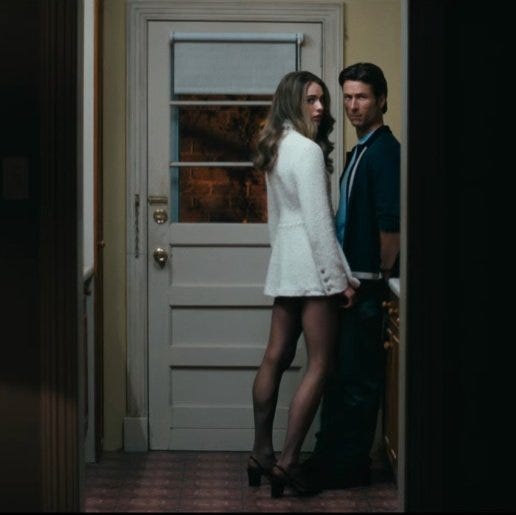
The pickings were looking slim again last weekend when I was deciding what movie my son and I should see on our weekly outing. We settled on the new Glen Powell flick How to Make a Killing, largely because it was a Glen Powell vehicle, a decision that overrode the mediocre reviews. The wager paid off: this was an entertaining and provocative movie that I recommend warmly when it shows up on a streaming service near you.
How to Make a Killing is loosely based on the classic 1949 British film Kind Hearts and Coronets, a product of its famed Ealing Studios. In that movie, the legendary Alec Guinness—remembered today for what he considered the throwaway role of Obi-Wan Kenobi—played eight different parts in a story about the illegitimate and orphaned son of a wealthy family who picks off a series of heirs in a quest to inherit the family fortune. In this iteration, Powell is Becket Redfellow, the black sheep of a Long Island dynasty who grows up in Newark before landing in a Manhattan men’s clothier. It’s there he encounters the Gatsby-like Daisy figure of his childhood—actually, Stella of Charles Dickens’s Great Expectations fits better—and daydreams about landing the money and the girl. (In a perfect piece of casting, she’s played by Margaret Qualley, whose kaleidoscopic persona contains multitudes.) Naturally, the cousins, aunt, and uncle are Becket dispatches are richly deserving of their deaths. One of the discomfiting things about How to Make a Killing is how utterly believable the louche characters are in an American empire at an advanced state of class-ossified decadence. This Horatio Alger lives in a corrupt culture, and plays his hand accordingly.
What’s pleasing about How to Make a Killing is the way its murderous plotline becomes secondary, as Becket finds himself genuinely liking one of his uncles (the reliably wonderful Bill Camp), who gives him a chance to shine at his firm. Becket falls in love with his deceased cousin’s ex (Jessica Henwick, also appearing these days in the Netflix series Vladmir), who’s pursuing her own dream of becoming a teacher. The narrative texture here is welcome and absorbing.
The best part about How to Make a Killing is its ending, which I of course will not disclose. I’ll note that the movie opens with Becket hours away from his execution for murder, telling the story you’re about to watch to a chaplain who has come for last rites. It’s in the nature of such stories, particularly one with a buoyant protagonist, that a last-minute dispensation will arrive—and it does, of a sort. The clincher is Powell’s priceless expression in the final shot. I was reminded of the 1967 film The Graduate, which ended on a comparably surprising note with its newlyweds’ faces. In that case, the final frame conveyed the question “What the hell do we do now?” In this movie, the answer is all too clear—and satisfying. Because everything has its price.