Thrillingly Normal
On the wonderfully relatable Rhea Seehorn

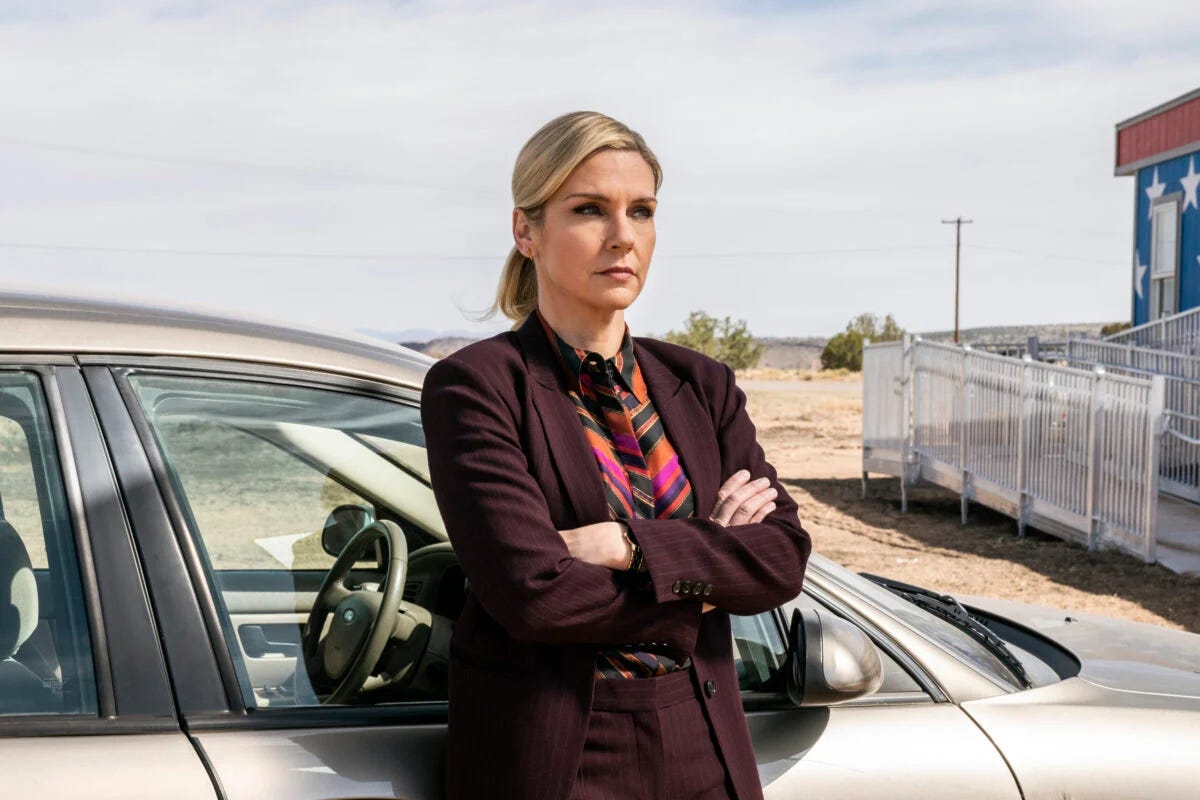
When I began watching Better Call Saul in 2015—I liked it even more than its prequel, Breaking Bad, which is really saying something—I found myself asking, “Who is this Rhea Seehorn, and why haven’t I seen her before?” From time to time, I wondered why I hadn’t seen her since. And then, when I began watching the new Vince Gilligan series Pluribus on Apple TV this week, I found myself asking, “Why has it taken this long?”
I don’t really know the answers to these questions. I can only say that I find Seehorn to be a deeply engaging performer, and she has me watching what I classify as a TV show about zombies—which is really saying something.
I think what I found so compelling about Seehorn in Better Call Saul is that as attorney Kim Wexler, she seemed like such a smart and sensible person. As such, she was a wonderful foil for Bob Odenkirk’s Saul Goodman, a defense lawyer whose volatile charisma repeatedly got him in deep trouble. (I loved Odenkirk in the two Nobody action movies he’s done since.) And yet theirs was a marriage of true minds. In the curious chronology of the series—we know from the moment it begins that the relationship is doomed because Kim is not a part of the Breaking Bad saga that follows—the joy of their chemistry is mixed with melancholy.
In trying to put my finger on what it is that I find so compelling about Seehorn’s Kim, I think it’s because she seems so deeply and utterly human. Better Call Saul was populated by larger-than-life characters, including seductively evil figures like Lalo Salamanca (Tony Dalton) and Saul’s tragically brilliant brother (the amazingly versatile Michael McKean, whose comic performances in Laverne & Shirley and This Is Spinal Tap are gold). In a way, Kim was a stand-in for the viewer: motivated by a keen intellect, but also emotions like love and fear to which we could all easily relate. Even her mild streak of kleptomania somehow seemed part of a portrait of a recognizably three-dimensional figure in her imperfection.
In Pluribus, which just started running last week, Seeahorn plays Carol, a deeply cynical writer of highly successful romance novels. Her pleasant veneer cannot fully contain her unhappiness, even rage, which she sublimates as a lesbian by turning the protagonist in her novels into a (more commercially viable) man. While Carol is not as pleasing a character as the one she played on Better Call Saul, her modulated irritability in doing her job (in this case, an enviably successful book tour) is immediately familiar. And when, all of a sudden, her world gets turned upside down by aliens who mysteriously seize the bodies of nearly all of humanity, her terror and bewilderment are very much of the kind we’d feel in her shoes.
That bewilderment is all the more intense because these body snatchers seem to make their hosts happy, though in an inevitably creepy way: they use first person plural pronouns as if there are now part of a single organism (hence the title pluribus—Latin for “many”—which is actually rendered “plur1bus,” a play on our national motto: “e pluribus unum”: out of many, one). They are also suspiciously willing to help her do whatever she pleases. For reasons the aliens don’t understand, Carol, along with a dozen other people on the planet, could not have their consciousness colonized. The trajectory of the series will presumably reveal why that is and whether she will maintain her autonomy.
This kind of show is not really my thing. My taste for sci-fi is limited; that for horror is almost non-existent. (I made an exception for The Silence of the Lambs, which I regard as one of the greatest movies I’ve ever seen.) But if Rhea is leading, I will follow. I love normal people.