Weathering Time
This has been the winter of our discontent

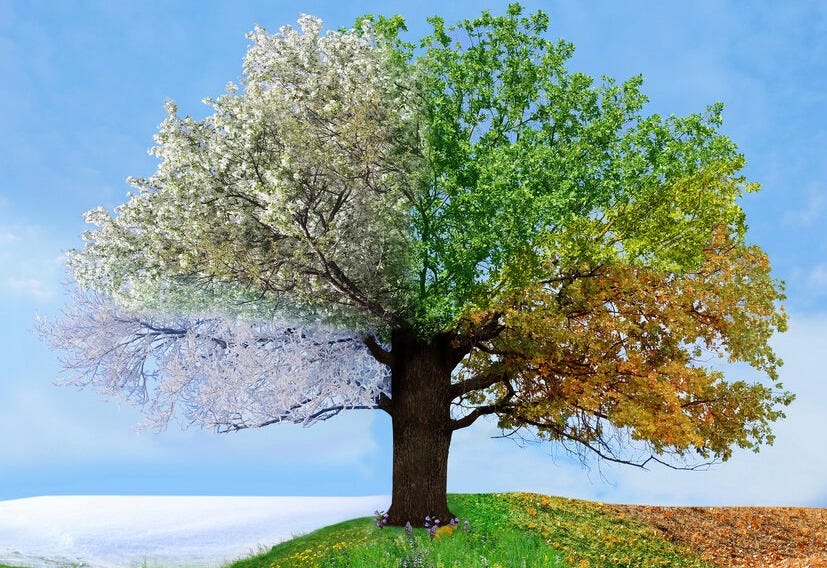
I’ve been thinking a lot about the weather lately, which is not something I typically I like to think about. Indeed, one pleasure (at times a vice) in the life of the mind is ignoring the outside world. Even when I do engage immediate reality, I consider the weather the first refuge of the dullard: that which you talk about when you really have nothing to say. But sometimes—and I think the winter of 2026 on the Atlantic seaboard falls into this category—weather has a way of asserting its power. Which can be immense.
As I reflect upon it, I think the experience of weather falls broadly into three categories. The first is weather that can be safely disregarded. It doesn’t matter what it’s doing outside if you’re vacuuming your house, chatting with a friend, or sleeping in your bed. Or, for that matter, playing on a field. Then there’s weather you take into account as you go about your business. A jacket or boots you might not otherwise wear. (Maybe a color you might otherwise wear.) You might carry an umbrella—or regret it if you don’t. Or take pictures to document foliage or other phenomena.
And, then finally, there’s weather that cannot be ignored, weather that poses a threat to your safety. Severe heat or cold. Storms of wind, snow, or lightning. Downpours of frogs (well, maybe only in the Book of Exodus or Paul Thomas Anderson’s 1999 film Magnolia.) Weather that gives you pause—and sends you for shelter.
We seem to have had more than our share of such weather here in metropolitan New York this winter. After a sharp cold snap in early December and about 2 feet of snow on January 25th—followed by the longest deep freeze in decades—I figured the worst was behind us, that an imagined law of averages meant that the rest of the season would be mild. It took the better part of a week for forecasters to decide what promised to be a mild precipitation event was going to morph into a blizzard on February 22. (And once they did, their timing was off—I could have completed the trip I canceled before things really got bad and dumped even more snow than January’s storm.) Normal life was paused for three days. I picked precisely the wrong time to go to work last Wednesday, driving into a brief but intense squall on untreated roads that made for the second-worst drive of my life. (My worst took place in the winter of 1995, when I was living in New Hampshire and made a 45-minute trip in a storm to my job at the state university, only to learn it had shut down.) Such events have a way of concentrating the mind. Like an $800 ConEd bill.
All this said, I’m a little less inclined than I used to be to think of weather as something around which one maneuvers. It’s easier than it used to be to simply take it in when sitting by a pool, walking on a bike path, or just sitting by a window. It still has the power to annoy me. But also to come in under the roof of my mind.
Reminds me of the times when, as NY Teacher of the Year, I was called on to give talks at various educational forums, schools, etc. In the late 1990s, not everyone had a cell phone, things were not yet digitalized, communication less sophisticated than now. A snowstorm was predicted, but no one up in the Catskills let me know that they cancelled the big event. I drove over the slipperiest roads, the snow mounted up, and the 2-hour road trip took about five hours. Then, upon arrival at the fancy venue, I learned…cancelled. Last time I ever trusted people to actually be there without solid confirmation.
Another interesting, well written piece Jim.