Pretty Ugly
The man-handling politics of 'Vladimir'

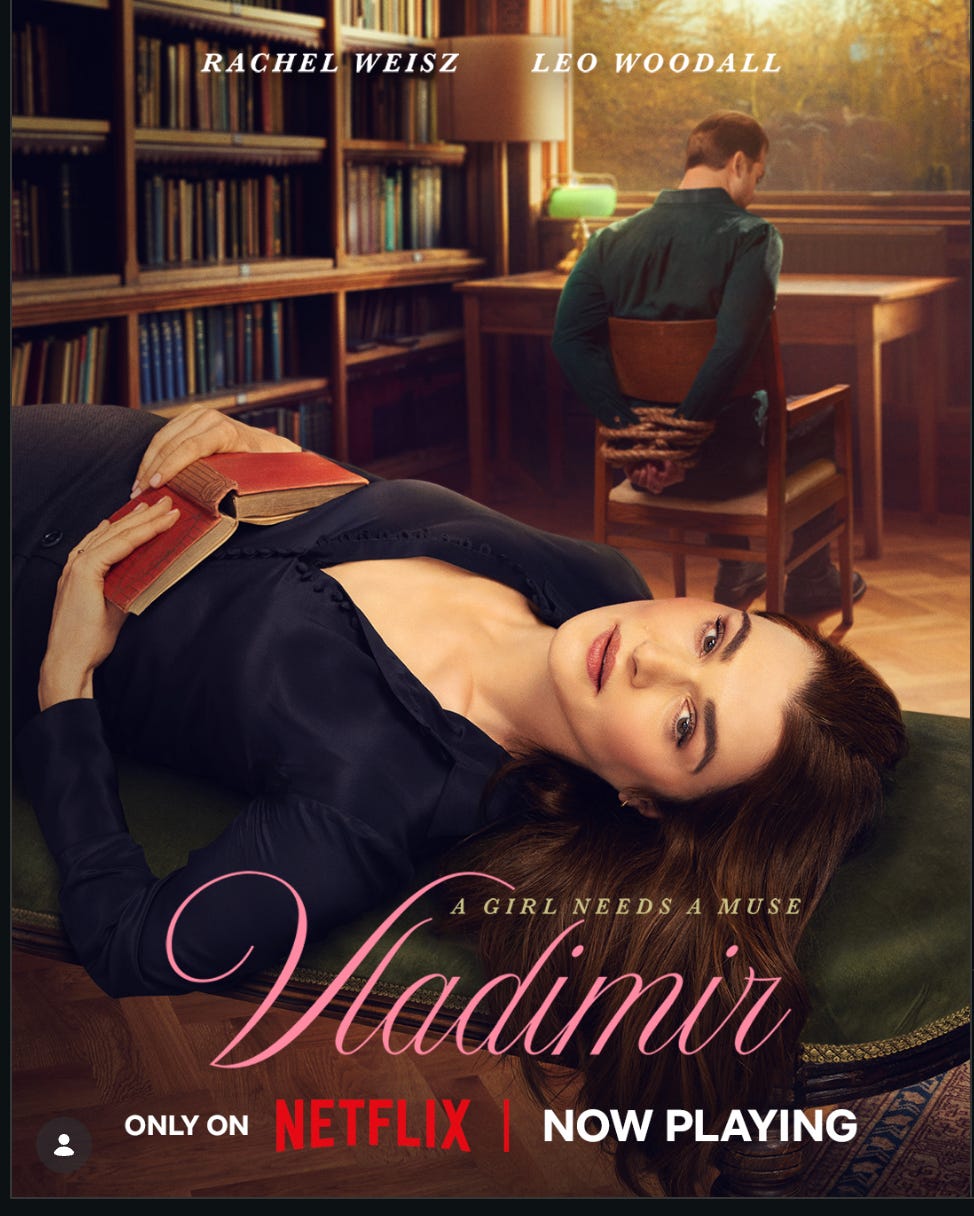
I’m not sure I dislike Vladimir for the right reasons.
Certainly, there’s plenty to like about the new Netflix satire of academic life—specifically, an English department at a liberal arts college in upstate New York. You can start with the cast, which includes Rachel Weisz, Leo Woodall, and John Slattery (playing, as he did in Mad Men, a likeable rake). The production design is terrific—a near fantasy of the archetypal campus. And the witty scripts include plenty of zippy one-liners and sharp literary references (each episode takes as its title a hip recent classic of American literature).
At its most basic level, Vladimir is a show about lust—specifically the lust of the middle-aged Weisz for her younger new colleague, Woodall. Since she’s in an open marriage with Slattery’s character (handily, a disgraced former professor undergoing an administrative process to deny him his pension for alleged sexual misconduct), this would appear to pose no ethical problem for her. The comic drama of the series is the way in which Woodall’s character plays the coquette: is he, isn’t he, into her? The fact that he’s married with a young child does not appear to be much of an obstacle; his wife, played by Jessica Fenwick, muses that she wishes he would have an affair because he’s so uptight.
The subtext here is that fretting about the morality of infidelity is at best beside the point and at worst an indication of antifeminist misogyny. (We witness a classroom discussion of Edith Wharton’s House of Mirth as a parable of sexual repression, which of course it is—among other things.) I’m mindful that I’m a guy who recently posted a positive review of How to Make a Killing, which treats murder as a comic premise, and will soon post the final installment of a series on The Sopranos, about a charismatic mobster. Given these two bookends, moralizing about extramarital affairs seems myopic, if not hypocritical. But in those cases, there is at least some unease about bad behavior, whether on the part of the characters themselves or in the moral architecture of the stories, which grapple with the extent to which crime pays. But in Vladimir, we’re presented with a protagonist who does some truly appalling things—beginning with the opening scene of the series, a flash-forward in which we see that she has chained her love object to a chair against his will—with nary an acknowledgment that she’s really done anything wrong while breaking the fourth wall to explain the contours of her inner life.
What really bothers me, though, is not so much the bona fide crimes—an improvised roofie is no less monstrous when a woman slips one in a drink than when a man does—but the way Vladimir valorizes self-gratification as a self-evident good, that this particular pursuit of happiness is as legitimate as any other. As such, it seems to me indicative, as indeed How to Make a Killing does, of a decadent rot that seems to have taken hold in bourgeois American popular culture. We can certainly see it in the political sphere on the right. And we can also see it in the cultural sphere on the left. Morality is for losers. (I’ll also have more to say about this in an upcoming post.)
I’m not comfortable with the role of the scold. That’s particularly true because I’m a historian of popular culture, and am well aware of generations of hand-wringing about the degeneracy of eighteenth-century novels, nineteenth-century stage shows, and twentieth-century popular music. Society is always in a state of perpetual decline.
But broken clocks are right twice a day. Vladimir seems to indicate that it’s getting late. Isn’t it?